Your crew talks, snaps and sends in the chat they already use. AI turns it into your own report form, from the pre-start Take 5 or JSA to the end-of-job report, and a person approves every word. For field operations managers in telecom, critical communications and data centres, set up around your forms, trades and approvals.
No reporting appNo app licencesNo formsNo loginsNo typing at 9 pmJust your company's own chat.
What changes
Less typing, fewer gaps, reports done the same day
Crew time back. No app to open and no form to fill. If they can send a voice note, they can do it.
Manager time back. No chasing or retyping. Gaps are asked for on the spot, and questions and approvals happen by voice in the same chat.
The report is ready. Complete, checked and approved the same day, before the crew gets home.
Safety checks get done. Pre-start Take 5s and JSAs / JHAs are talked through in the chat and recorded on your own safety form, not ticked on paper and lost.
No new system for IT to roll out: we work around the tools you already use.
See it in action
Built by people who've done the job
We've climbed the towers, run live cutovers and fixed the faults nobody wrote down. We built this so those details make it back to the office the same day.
From a voice note on site to an approved report, the same afternoon.
A fictional two-way radio job: Dan upgrades a council depot's repeater and reprograms its radio fleet. These are real screens from our demonstration.
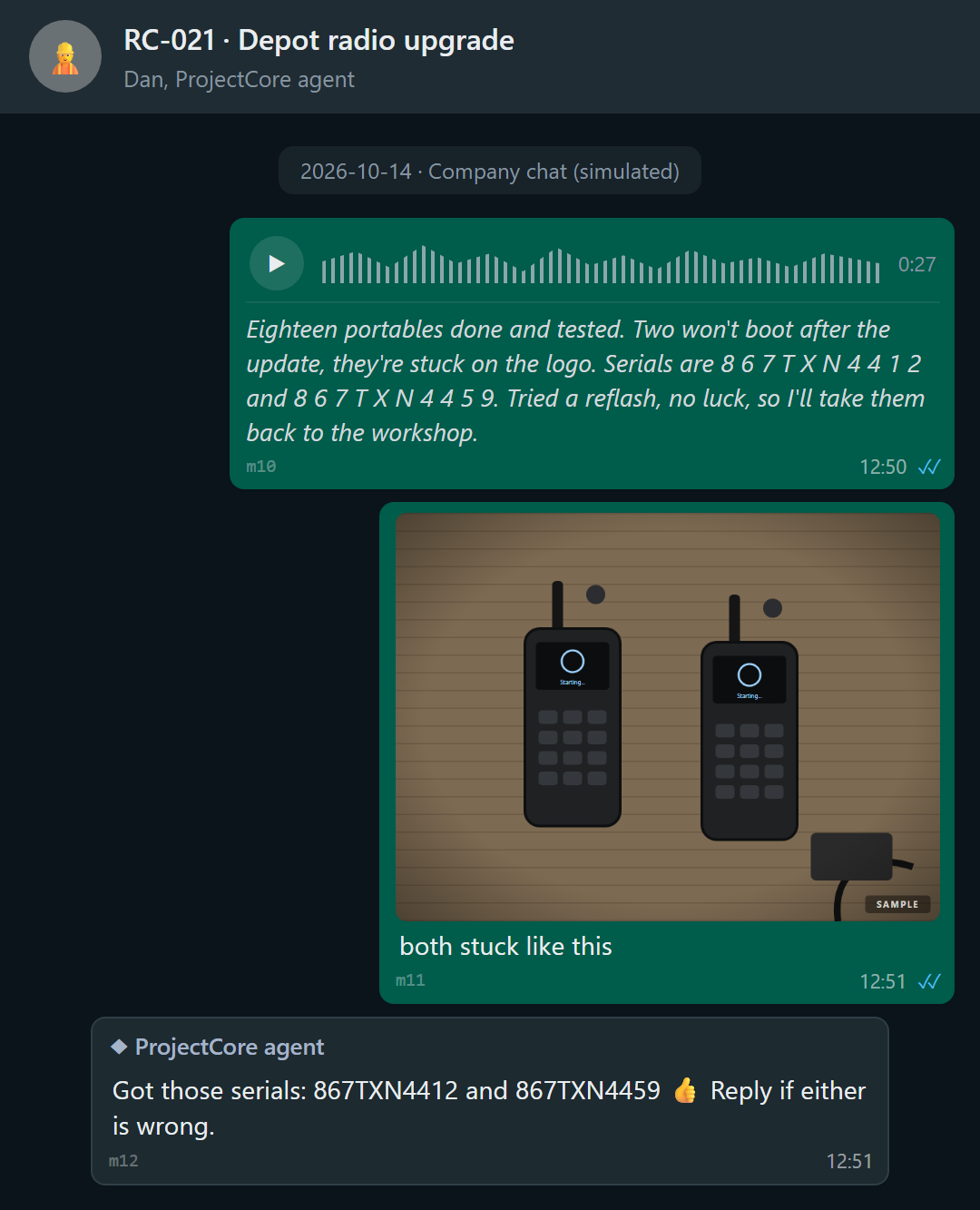
1Dan talks on site. Voice notes and photos in the company's own chat. Two radios won't boot; he reads out their serials, and our AI agent reads them back so nothing is misheard.
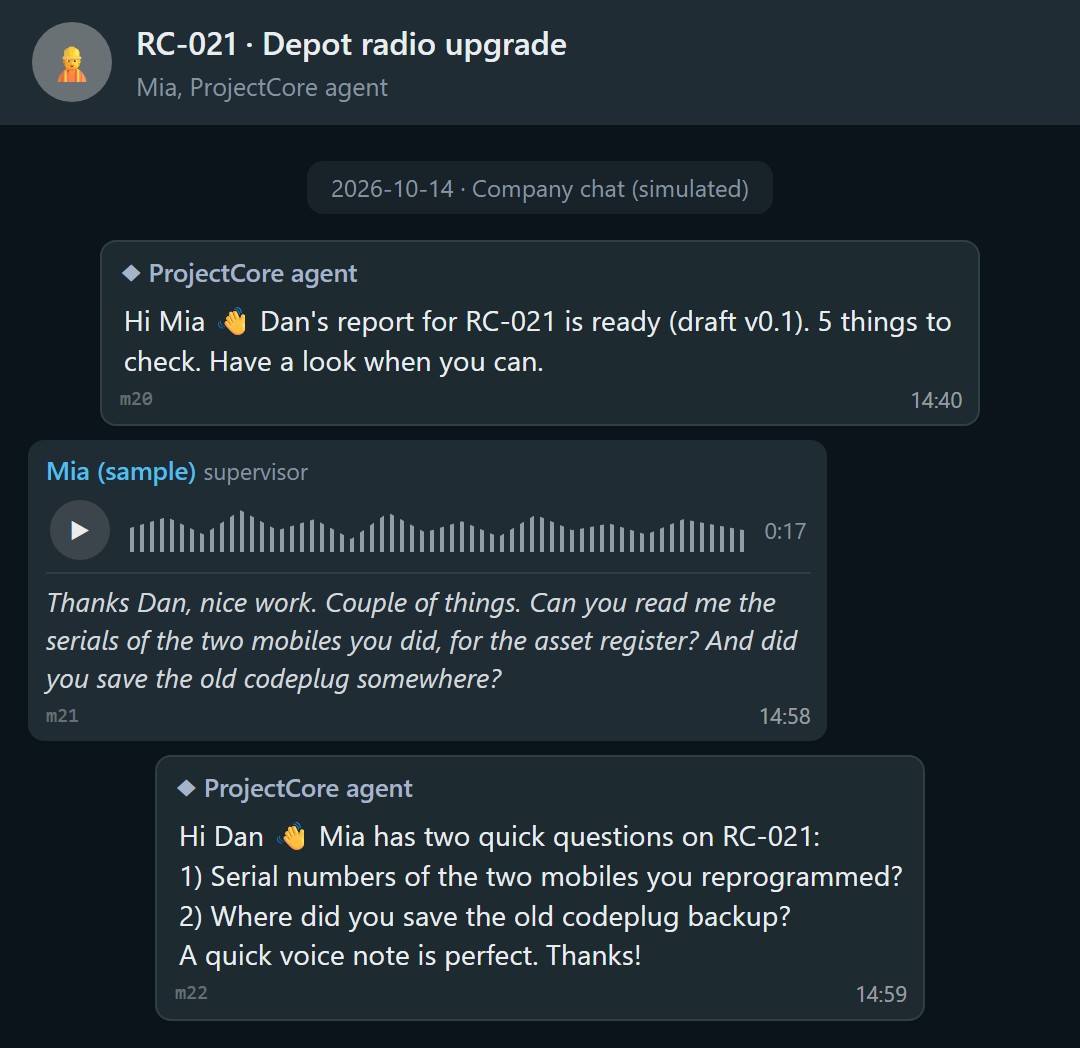
2The draft goes to Mia, the manager. She asks two questions by voice. The agent turns them into clear questions for Dan.
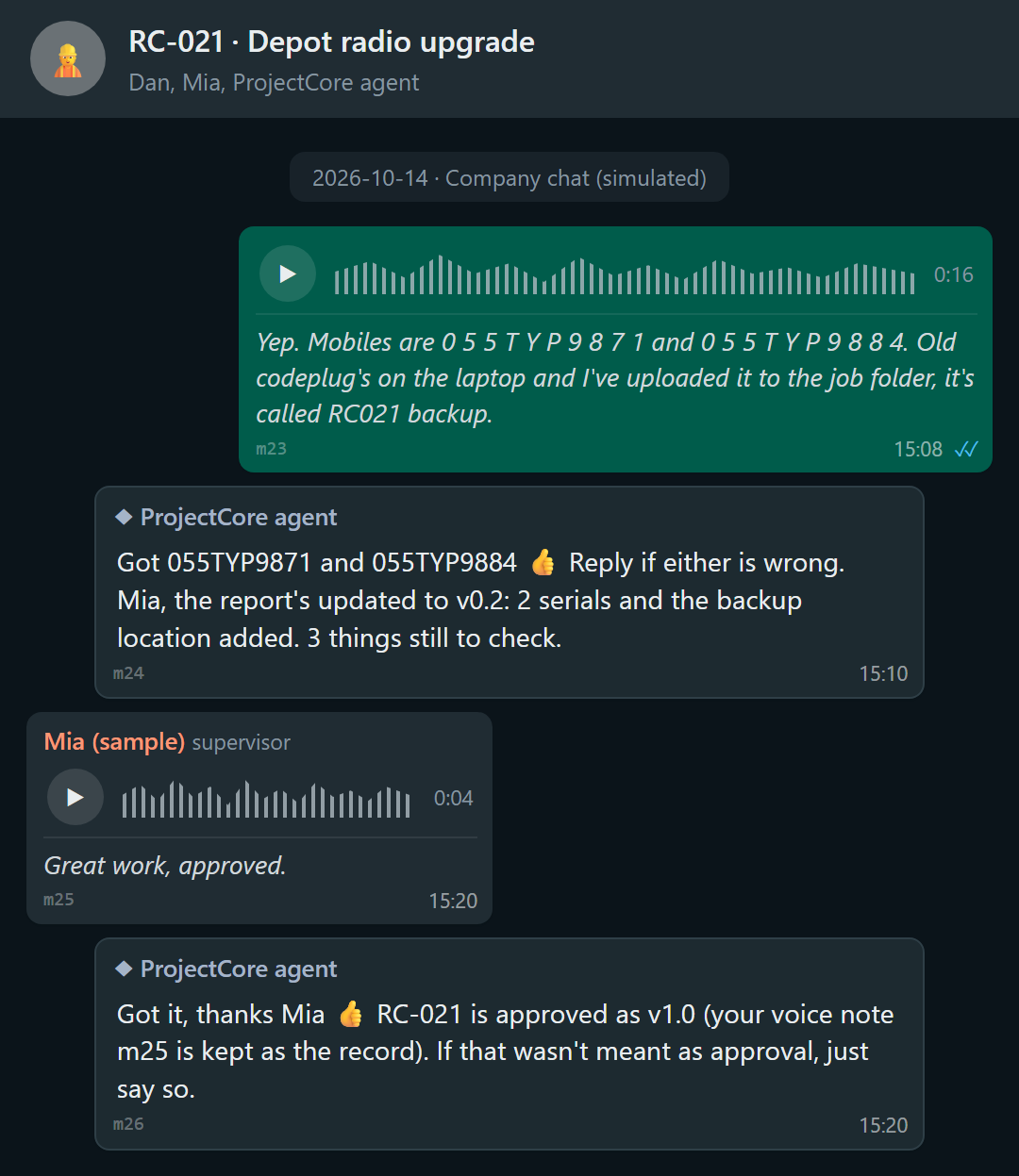
3Answers, then approval by voice. Dan answers, the report updates to v0.2, and Mia says "Great work, approved." The agent confirms it back.
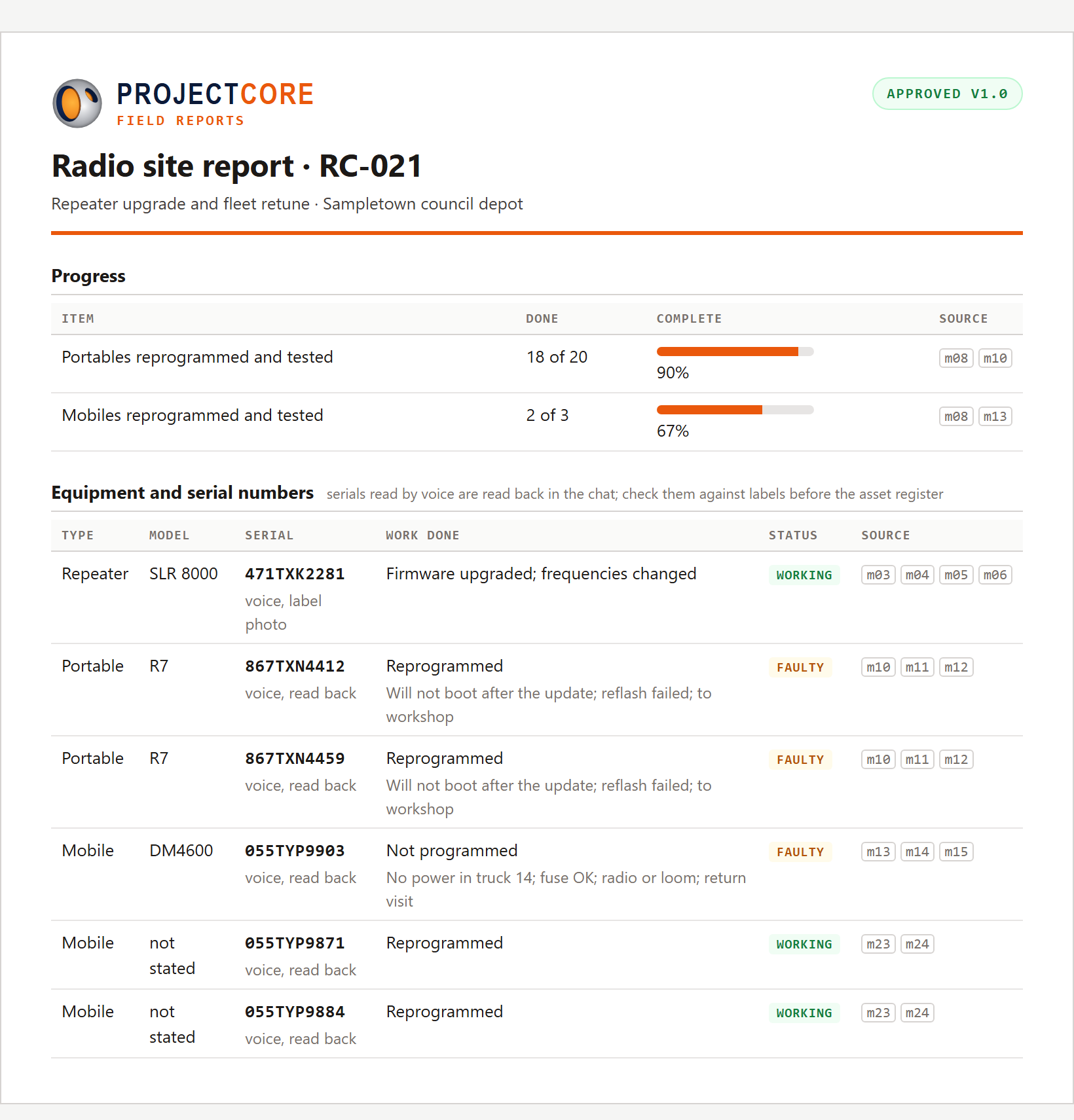
4The report, ready the same day. Progress, equipment and serials, faults and next steps. Every line traced to the message it came from.
Tap any screen to enlarge. Fictional job, people and serial numbers. See the whole process.
Field conditions
Built for wind, plant rooms and noisy sites
Noisy audio. Speech detection skips wind, plant-room and generator noise between words. The pilot tests it on your own crews' recordings.
Your trade's words. Terms like OTDR, VSWR, dBm, codeplugs, talk groups, splice trays and PDUs are recognised, and we add your own.
Live read-back. Serial numbers and critical readings are read back in the chat to confirm before they go into the report.
No guessing. If noise hides a detail, the agent asks again or flags it. It never fills in a value it did not hear.
First step
Start a 4-week single-crew pilot
Run one crew for 4 weeks and measure it against your current reporting time. No software rollout.
Week
What happens
You get
1
Set up and measure today. One trade, one crew and your main report form. We agree the approval steps, the chat platform and where your data lives, and record today's figures.
A working set-up and a baseline
2
First real reports. The crew talks, snaps and sends; the manager approves. We tune it every day.
Approved reports from real jobs
3
Improve. Questions and answers in the chat, reminders and weather care switched on.
A set-up the crew likes using
4
Measure and decide. We compare the results with the baseline, together.
A results summary: stop, adjust or extend
We measure reports approved the same day, time from the end of the job to approval, admin minutes per technician, missing details caught, and what the crew and managers think. From day one you get draft reports from voice notes and photos, approval before anything is issued, and PDF and spreadsheet files. During the pilot we connect your chat platform, form and approvals, and a link into your systems where your IT allows. The 4 weeks start once your IT has given the access we need; each next step is agreed and quoted on its own.
Your estimate
What could it be worth to you?
Put in your own numbers. This is an estimate, not a promise: the pilot measures the real figure.
The starting values are examples only. Calculated in your browser; nothing is sent to us. Not counted above: fewer return visits from missing serials and photos, faster client sign-off and invoicing, and near misses and variations captured on the day.
Questions
Questions we get asked
Does my crew need to install anything?
No. They keep using your company's chat platform, whichever it is: Microsoft Teams, Google Chat, Telegram, WhatsApp and others. No logins, no forms.
Can it use our own report forms and rules?
Yes, that is the point. We set it up around your forms, trades, approval steps and safety procedures.
Can it handle our pre-start safety checks?
Yes. Crews talk through a pre-start Take 5 or a JSA / JHA (Job Safety Analysis / Job Hazard Analysis) in the same chat, before work starts. AI records the hazards and controls in your own safety form, and a supervisor reviews it. The crew still does the check; AI just makes recording it quick, so it gets done every time.
What if the AI gets something wrong?
Nothing is shared until a person approves it. Every line links back to the message it came from, and anything unclear is flagged for the manager to check.
Is it ready today?
The core works today, and it is what you see in the demonstration: voice notes turned into text, the report drafted from the chat, serials read back, gaps flagged, questions and answers, versions and approval, and the finished PDF and spreadsheet. Each pilot connects it to your own chat platform, form and approval steps, and we check every step with you.
Where is our data kept, and which AI is used?
Your reports, photos and records stay in your own systems, such as Microsoft 365, Google or your own servers. The AI runs on your company's own AI subscription, such as Microsoft Copilot, Azure OpenAI, ChatGPT or Claude for business. If your chat platform is a public messaging app, messages pass through that provider's servers on the way. Exactly where each part runs is agreed with you in writing before the pilot starts. Smaller team without its own systems? We can set it up end to end for you.
Who owns what?
Your data, reports and photos are yours, always. The set-up we build is for your company's own use only. After the pilot, a maintenance and refinement agreement keeps it working as your crews, forms and systems change.
What about our crew's privacy?
Crews know exactly what is recorded and why. Only what they send to the job chat is used. There is no tracking, and arrive and leave times are used only to fill in the report, never to monitor or rate people unless that is agreed openly with your crews first.
How do the reports get into our systems?
From day one, as a PDF plus a spreadsheet such as an equipment list. With your IT team, we can also send approved reports straight into tools like SharePoint or your job management system, and feed your scheduling, management reports and project records.
How long does it take, and what does it cost?
Your pilot, for one crew, runs for 4 weeks. Because every client's work is different, we quote each project after the discovery call, then grow it step by step.
Talk to someone who's done field work.
You'll talk directly to the people who built it, not a sales rep. Tell us about your crews; we aim to reply within one business day.
Your request
Tell us a little about your crews, and we'll set up a time to talk.
The voice demo takes 5 minutes. A full walkthrough with us takes 20, with no preparation needed. Ask for access to the full demonstration here too.
We take on one delivery engagement and one field pilot at a time, so each client gets our full attention. Prefer email? [email protected]